

AI, Complaints and Consumer Vulnerability:
Are We Replacing Empathy with Efficiency?
By Consumer Friend
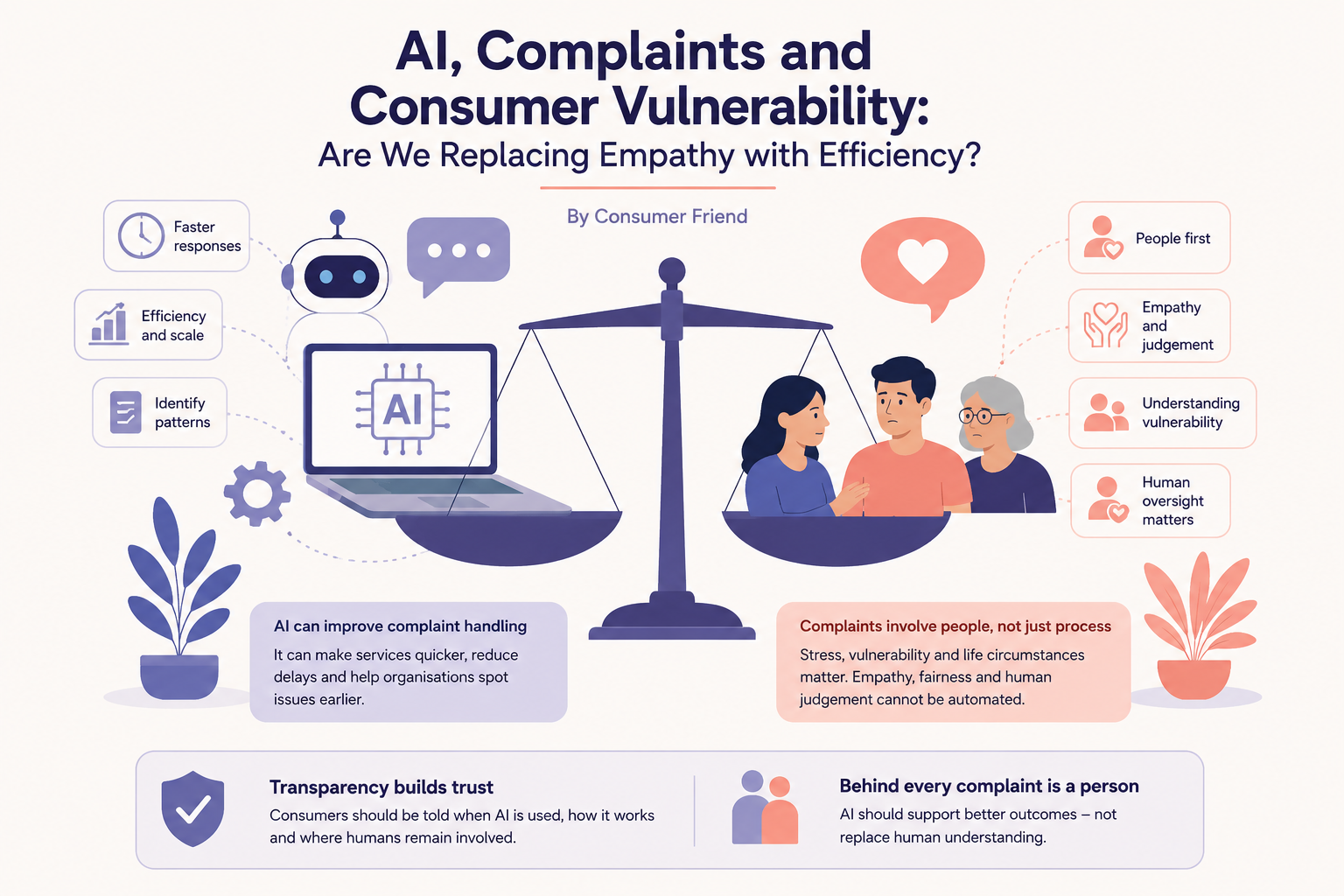
IMAGE CREATED BY CHAT GPT
Artificial intelligence is changing the way organisations deal with consumers.
From chatbots and automated complaint systems to tools that analyse behaviour and predict customer needs, AI is becoming part of everyday customer service. Businesses, regulators and alternative dispute services are all looking at how technology can make services quicker, cheaper and more efficient.
And there are real benefits.
Used well, AI could make complaint systems easier to use. It could help organisations spot when someone needs extra support, reduce waiting times and free up staff from repetitive admin tasks. It may also help organisations identify patterns and fix problems earlier.
For consumers, that could mean simpler processes and faster outcomes.
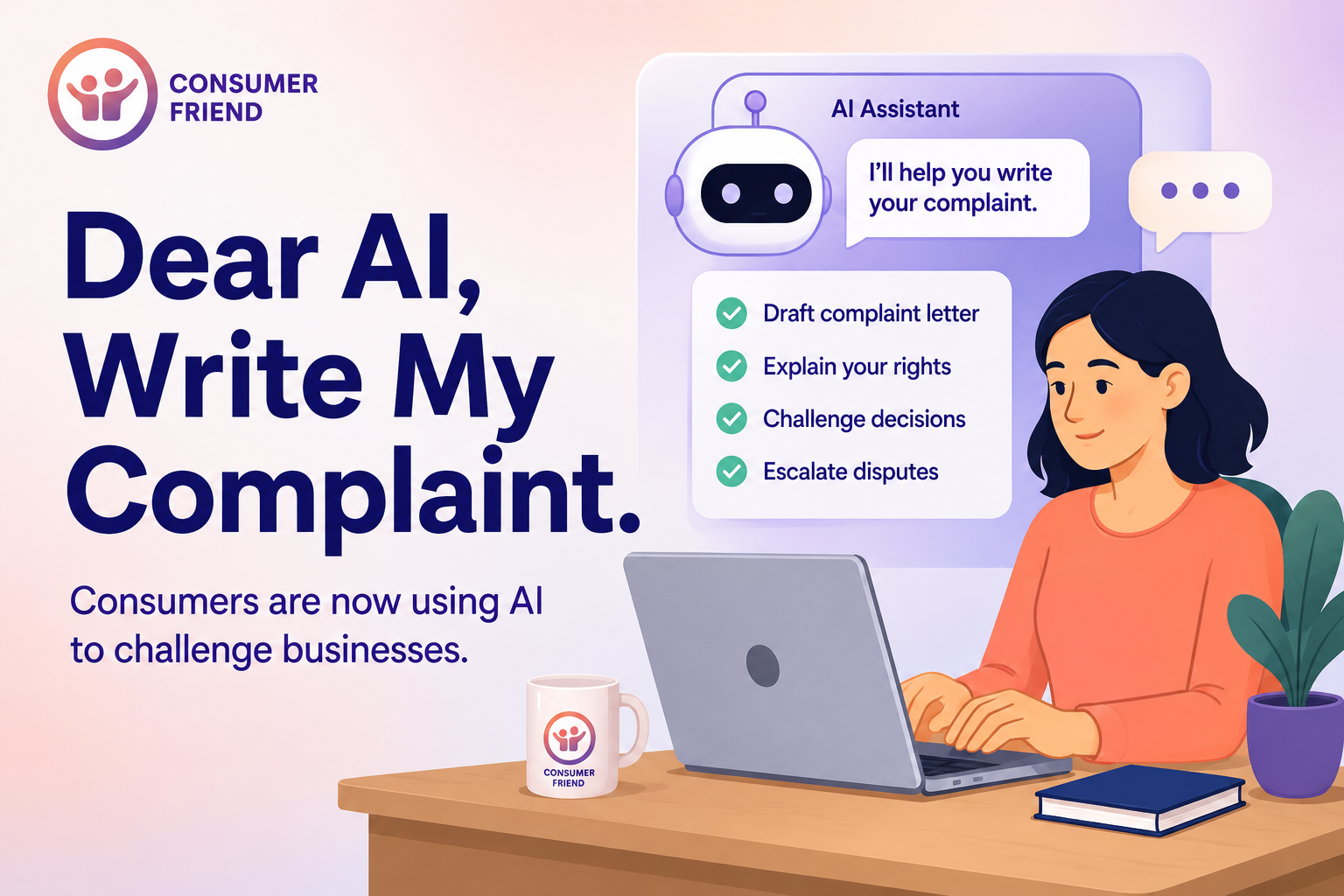
IMAGE CREATED BY CHAT GPT
But there is another side to this.
Complaints are not just processes. They involve people. Often people who are stressed, frustrated, confused or worried. Sometimes people are vulnerable, overwhelmed or struggling to explain what has happened.
AI can process information quickly, but it does not understand human experience in the same way people do.
As more organisations introduce AI into customer service and complaint handling, there is a risk that efficiency starts to replace empathy.
Many consumers are already dealing with AI without realising it. Organisations now use AI to run webchats, summarise complaints, prioritise cases and even analyse the tone of customer messages.
For organisations handling large numbers of complaints, this can sound like the perfect solution. AI promises quicker responses, lower costs and greater consistency.
In some situations, it may genuinely improve the consumer experience. Long complaint journeys could become simpler and less stressful. AI tools may also improve accessibility by helping to simplify language or offer translation support.
Those improvements matter.
However, consumer vulnerability is not always easy to spot.
People communicate differently when they are stressed or upset. Some struggle to explain things clearly. Others may provide too much information or not enough. Some consumers may communicate differently because they are neurodivergent, for example they may be autistic, have ADHD or dyslexia.
This is important because AI systems are built around patterns. They often look for what is considered “typical” behaviour or communication.
But people are not all the same.
A neurodivergent consumer may communicate in a very direct or factual way without showing emotion. Another person may sound angry because they feel ignored or overwhelmed. Someone else may struggle to organise information clearly because they are stressed.
AI may misunderstand these situations.
The issue is not necessarily that AI is biased on purpose. The problem is that systems trained on “normal” communication patterns may fail to understand difference.
That matters because complaints are often about more than the problem itself. A complaint about a delayed delivery, faulty product or poor service may also involve financial pressure, health problems, caring responsibilities or other personal difficulties.
Those things are not always visible to automated systems.
One of the biggest risks is that organisations start seeing complaints as problems to process rather than people to support.
AI is often introduced to improve efficiency, reduce costs and manage workloads. But faster does not always mean fairer.
Good complaint handling still depends on human skills such as listening, empathy, judgement and reassurance. Consumers often remember how they were treated far more than the final outcome itself.
IMAGE CREATED BY CHAT GPT
A technically correct response can still leave someone feeling dismissed or ignored.
There is also growing interest in using AI to identify vulnerable consumers by analysing language, behaviour or emotional tone. The intention is usually positive. Organisations want to identify people who may need extra help.
But vulnerability is personal and complex. Some people hide distress well. Others become frustrated because they are overwhelmed. Some may not appear vulnerable at all. AI systems can miss these signs completely.
There is also the risk that staff rely too heavily on automated assessments. If a system wrongly decides someone is “low risk” or “low priority”, important concerns could be overlooked.
Digital exclusion is another concern.
Not everyone is comfortable using chatbots, apps or online complaint systems. Some consumers struggle with digital services, accessibility barriers or literacy. Others simply want to speak to a real person.
If organisations rely too heavily on automation, some consumers may give up before they get the help they need.
And when systems are difficult to access, they can quickly become unfair.
None of this means organisations should avoid AI altogether.
Technology can absolutely help improve complaint handling and consumer support. But AI should support human decision-making, not replace it. The organisations that use AI well are likely to be the ones that keep strong human oversight, design services inclusively and recognise that technology has limits.
Most importantly, they will remember that behind every complaint is a person.
A debate we have recently been involved in. Should consumers be told when AI is being used?
As more organisations use AI in complaint handling and customer service, transparency matters.
If AI is influencing decisions, prioritising complaints or analysing consumer behaviour, customers should be clearly told. Most people are not concerned about basic automation or spellcheck tools, but they do have a right to understand when technology may affect outcomes or how their complaint is handled.
This is becoming increasingly important for regulators too. The Information Commissioner's Office has repeatedly said organisations should explain when automated systems are being used, what they are doing and how decisions are made.
There is also a practical reason for being open about AI. Some consumers may feel uncomfortable sharing sensitive information with automated systems or may worry about being misunderstood. Others may actually prefer AI-driven services because they find them quicker or less intimidating. Giving consumers clear information allows them to make informed choices.
Simply hiding “AI may be used” in a privacy policy is not enough. Good practice means using plain English and being honest about where humans remain involved.
Something as simple as:
“We use AI tools to help organise complaints more quickly, but all decisions are reviewed by trained staff.” Can go a long way towards building trust.
The biggest risk is not AI itself. It is consumers feeling they are being assessed or managed by systems they were never told about and do not understand.
Consumer services are changing quickly and AI will continue to shape the future of complaint handling. There are real opportunities to improve services and reduce frustration for consumers.
But there are also real risks if organisations become too focused on efficiency and not focused enough on humanity.
Technology may help organisations work faster.
But trust is still built by people.
Want to prepare your organisation for AI generated complaints?
Consumer Friend is launching practical training to help organisations understand, manage and de escalate AI generated complaints while maintaining fairness, empathy and good consumer outcomes.
Contact us at:
info@consumerfriend.org.uk