By Lou Baxter MBE, Consumer Friend
Christmas deals can be tempting. You’ve got Christmas presents to buy, you see a big ‘save £250’ sign and you think you’d better get it now. I’d ask one question before you do. Was it ever really that price?
Which? tracked 756 products across eight major UK retailers. Only 22% were cheaper during the four-week Black Friday sales period in 2025 than at any other point in the year it tracked. Another 44% matched a price that had already been available earlier in the year. One TV was £999 at John Lewis on Black Friday and £749 at the same retailer on Christmas Eve. That’s £250 less for the same TV a few weeks later. Which? research
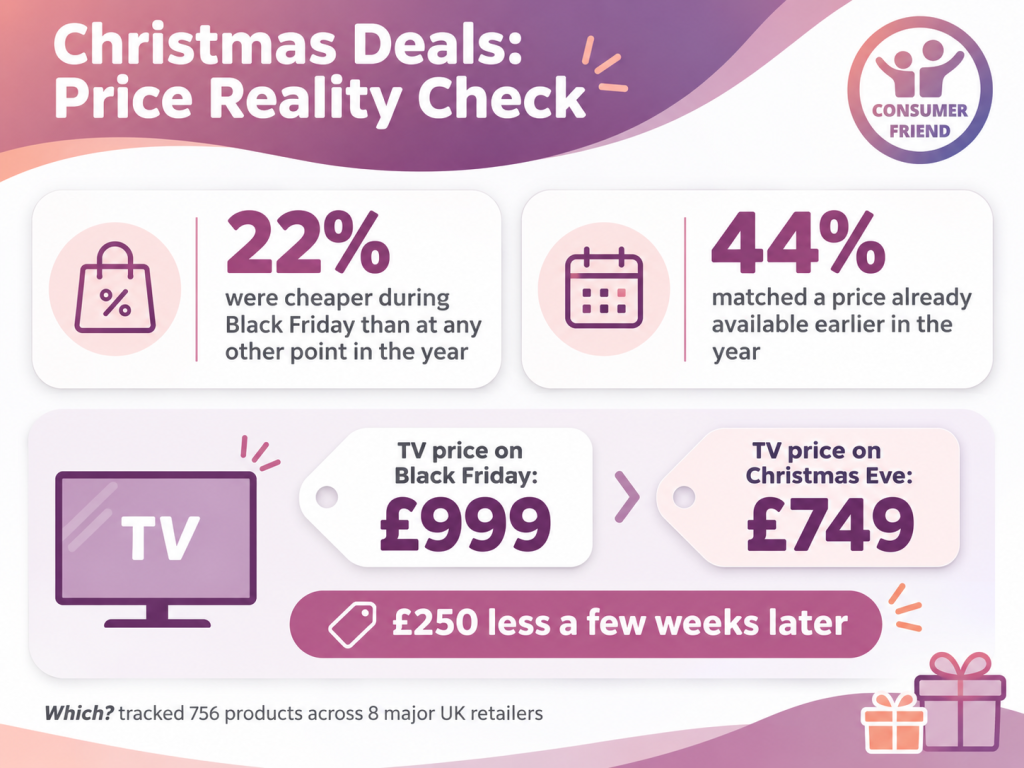
Christmas Deals: Can you prove the saving?
Prices go up and down. That TV getting cheaper in December tells us what someone could have saved by waiting. If a retailer puts a price up and then uses it as the ‘was’ price in a sale, the question I’d ask is whether that higher price was genuinely what the product usually sold for. ASA guidance on promotional savings claims
In May 2026, the Advertising Standards Authority ruled that a large retailers Black Friday advert claiming a £450 saving on a laptop was misleading. The laptop had been priced at £1,099 for 47 days before it dropped to £649. It had previously been offered for as little as £749. The ASA said there wasn’t enough evidence to show that £1,099 was the usual selling price. ASA ruling on John Lewis
Who has the time or money to sort it out?
This is where consumer vulnerability comes in. Think about someone trying to buy a Christmas present on a tight budget, or a carer fitting their shopping into ten minutes between appointments. An unexpected fee at checkout can mean going over budget or starting the search all over again. If you’re already stretched, either option can be a hard choice.
There’s a cost to that. Government research estimated that fees revealed late in the online checkout process led UK consumers to spend an extra £595 million to £3.5 billion a year, excluding delivery fees. That’s drip pricing. You see one price at the start and only find out about extra charges as you go through checkout. Department for Business and Trade research
There’s also the time people spend dealing with problems. A government impact assessment estimated that shoppers in Great Britain spend about four million hours a year dealing with misleading prices and information in the food and drink sector. It valued that time at £68 million a year, or £2.48 per household, using 2024–25 prices. Apply that household average across the UK and it comes to around £71 million a year in lost time, assuming the average cost per household is the same in Northern Ireland. Government impact assessment · ONS household figures
When I talk to businesses about consumer vulnerability, this is the sort of thing I want them to look at. Can someone see the full cost at a glance? Can they tell what they’re buying without opening three tabs? If there’s a limit on stock, will they know before they make the trip to the shop? These are everyday decisions a business can get right before a customer has to spend time sorting out a problem.

What does the law say?
Under the Digital Markets, Competition and Consumers Act 2024, a false or misleading claim about a price or saving is unlawful if it’s likely to lead the average consumer to make a decision they otherwise wouldn’t have made. When businesses advertise a price for something customers can buy, they must include mandatory charges in the total upfront where those charges can reasonably be calculated in advance. Section 226 of the Act · CMA guidance on price transparency
The Act also bans bait advertising and bait-and-switch. Bait advertising is when a business offers a product at a set price without telling shoppers it has reason to believe it can’t supply the product, or an equivalent, at that price in reasonable quantities for a reasonable time. Bait-and-switch is when a business advertises an offer and then, for example, refuses to take an order for the advertised item because it intends to promote a different product. Schedule 20, paragraphs 5 and 6
Getting Consumer Pricing Right
Before your next promotion goes live, ask the people putting it together three questions. Can we prove the saving? Can customers see what they’ll actually pay? Can we supply what we’ve advertised?
That’s why we’ve developed Getting Consumer Pricing Right, our new e-learning at Consumer Friend. It takes around 40 minutes and uses practical examples to help teams check discounts, price comparisons and checkout fees. It’s available through our learning portal or as a SCORM package for your own learning platform. Consumer Friend course information
To find out more or arrange training for your team, visit the Consumer Friend website or email info@consumerfriend.org.uk.